
Which Franklin Records Are Open
Franklin public records do not sit in one database. A city permit belongs to a municipal department, a deed belongs to the Williamson County Register of Deeds, and a state felony supervision record belongs to the Tennessee Department of Correction. Tennessee citizens may inspect existing government records under the Tennessee Public Records Act unless another statute, court order, or rule closes the material. The law does not make an office answer research questions or create a list that does not exist.
| Franklin record group | Office that keeps it | Web access | Other access |
|---|---|---|---|
| Deeds, liens, releases, plats | Williamson County Register of Deeds | ProAccess host; start year and image terms not published | Counter, telephone, copy request |
| Property ownership and assessment | Williamson County Property Assessor | County Property Search or TPAD | Assessor staff and county mapping |
| Trial court files | Municipal, General Sessions, Circuit, Chancery, or Probate clerk | Varies by court | Clerk counter, terminal, or written copy request |
| Historical courts, marriages, wills, deeds, taxes | Williamson County Archives | Cross-record name index | Reading Room, phone, email, mail, ordered copy |
| Birth, death, marriage, divorce certificates | Tennessee Vital Records; local issuing offices | Applications and ordering guidance | Local counter, state counter, mail, official online order |
| Police, jail, and offender information | Franklin Police, Williamson Sheriff, TDOC, or TBI | Agency request forms, FOIL, registry | Agency-specific request or telephone |
Access can differ within one record group. An index may show a party, date, and file reference while the image remains at the counter. Sealed and expunged cases, juvenile and adoption matters, recent vital certificates, protected addresses, motor-vehicle personal data, and specified identifiers are not ordinary open files. Redaction may permit release of the rest.
Franklin Deed Records and ProAccess
The Williamson County Register of Deeds records deeds, deeds of trust, releases, liens, plats, easements, and related instruments. Its remote ProAccess service is the official online host. The public material reviewed for Franklin did not state the exact first online year, complete field labels, or whether every document image is free. Those points should be checked in the live system instead of assumed.
A party-name search should cover both grantor and grantee roles. The grantor gives or transfers an interest; the grantee receives it. Try initials, former names, spelling variants, trusts, and associated entities. Once an index hit supplies an instrument number or book and page, that stable key can be used to retrieve the image or request a certified copy. If remote access fails, call 615-790-5706 or visit Suite 201 at 1320 West Main Street, Monday through Friday, 8:00 a.m. to 4:30 p.m. Older deeds may instead be located through the Archives.
Note: Military discharge documents can carry special access limits, so confirm eligibility with the Register before requesting a DD-214.
Franklin Archives Record Index
The Williamson County Archives Online Index joins many older record families in one name search. Its About page reports more than 365,000 entries, while the newer county collections page reports more than 400,000. Since indexing continues, the difference is best read as growth rather than a fixed count. Courts, marriages, wills, deeds, taxes, obituaries, burials, and other groups can all point to a person.
| Archive search mode | Entry type | Required input | How it behaves |
|---|---|---|---|
| Browse record index | Browse mode | None | Shows available record groups |
| Name across database | Name search | Name | Searches all indexed groups |
| Name in selected groups | Name plus group filter | Name | Limits results to one or more chosen groups |
| Result entry | Clickable locator | Selected result | Opens details and the source reference |
An entry is often a locator, not a downloadable scan. It may direct staff to microfilm, a bound book, or a loose file. The Archives Reading Room at 611 West Main Street is open on weekdays, and staff accept questions by phone, email, and mail. Copies can be ordered when travel is not practical. Modern filings remain with the office that currently creates them.
Franklin Property Records and TPAD
The Williamson County Property Assessor maintains ownership records, taxpayer indexes, cadastral maps, and the assessment roll. The county property search is the direct local route. Tennessee Property Assessment Data, or TPAD, is a documented official alternate that includes Williamson County. Its simple search accepts an owner name, property address, or parcel ID. Advanced controls add subdivision, classification, sale dates, and parcel components.
Keep the situs address separate from the tax-mailing address. Situs means the physical site. The mailing field is where owner correspondence goes, and it may point elsewhere. Neither field alone proves where a person lives. Assessment data also does not establish title. Use the parcel ID and legal description to reach the deed index when the legal ownership trail matters. County GIS supplies parcel context, but the public office page did not expose a stable list of every map layer.
Jurisdiction check. A Franklin postal line can fall outside city limits. Use official GIS boundaries before sending an address-based request to a city department.
Franklin Court Records by Custodian
There is no single Tennessee trial-court name portal that replaces the local clerks. Franklin Municipal Court handles city traffic, parking, fire, code, and ordinance matters, but no official public name index was verified. Current General Sessions, Circuit, Chancery, and Probate files must be sought from the clerk for that court. Historical cases may appear in the Archives index. Juvenile files and sealed or expunged matters must not be treated as open name records.
The Williamson County Circuit Court Clerk holds Circuit and General Sessions material. Tennessee's appellate Public Case History covers appeals, not every local filing. Federal cases for Williamson County use PACER, which requires an account and may charge under the current federal schedule. For an offline request, give the court, party name, approximate year, case type, and case number if known. Ask the clerk whether inspection, a plain copy, or a certified copy best meets the need.
Note: A divorce certificate comes from vital records, while pleadings and orders remain in the separate Circuit Court case file.
Franklin Vital Records Boundaries
Tennessee Vital Records issues statewide birth, death, marriage, and divorce certificates. A county health department can issue registered statewide birth and death certificates through electronic issuance. The Williamson County Clerk handles local marriage records, while the Circuit Court keeps the divorce case file. Applications may be made through the channels listed by Tennessee Vital Records, including a local counter, state counter, mail, and the official online route.
Recent certified copies are controlled by entitlement and identification rules under Tenn. Code Ann. §§ 68-3-205 and 68-3-206. The state fee is $15 per copy, and a no-record letter carries the same search charge. A mail packet needs the signed form, payment, proof of identity or a notarized signature, and entitlement documents when required. Historical access follows a different line: births become public after 100 years, while deaths, marriages, and divorces or annulments become public after 50 years. Eligible older Williamson material can move into archive-based research.
Franklin Public Records Custodians
The correct office saves time because Williamson County's general request process does not retrieve Franklin municipal files, school records, or all law-enforcement material. These three local contacts cover many deeds, assessments, and older cross-record searches. Court and police requests still go to their own clerks or records units.
Register of Deeds
1320 West Main Street, Suite 201
Franklin, TN 37064
615-790-5706
The Register and Archives list weekday hours of 8:00 a.m. to 4:30 p.m. The Assessor has had staff split between Suite 313 at the Administrative Complex and 305 Beasley Drive, so calling before a visit is wise. County Clerk questions about modern marriages use that office; older indexed marriages may be at Archives.
Franklin FOIL and Registry Records
Custody sources cover different systems. The Williamson County Sheriff is the local route for jail information, but no stable official public roster interface was verified. A sheriff records request is the fallback. Tennessee's Felony Offender Information Lookup covers current and former TDOC felony custody or supervision. It does not stand in for a county booking log. The TBI Sex Offender Registry is separate again and supports name, partial name, address, county, offender ID, and status filters.
The captured Tennessee FOIL search shows the state name and identifier controls used to find a felony offender record.
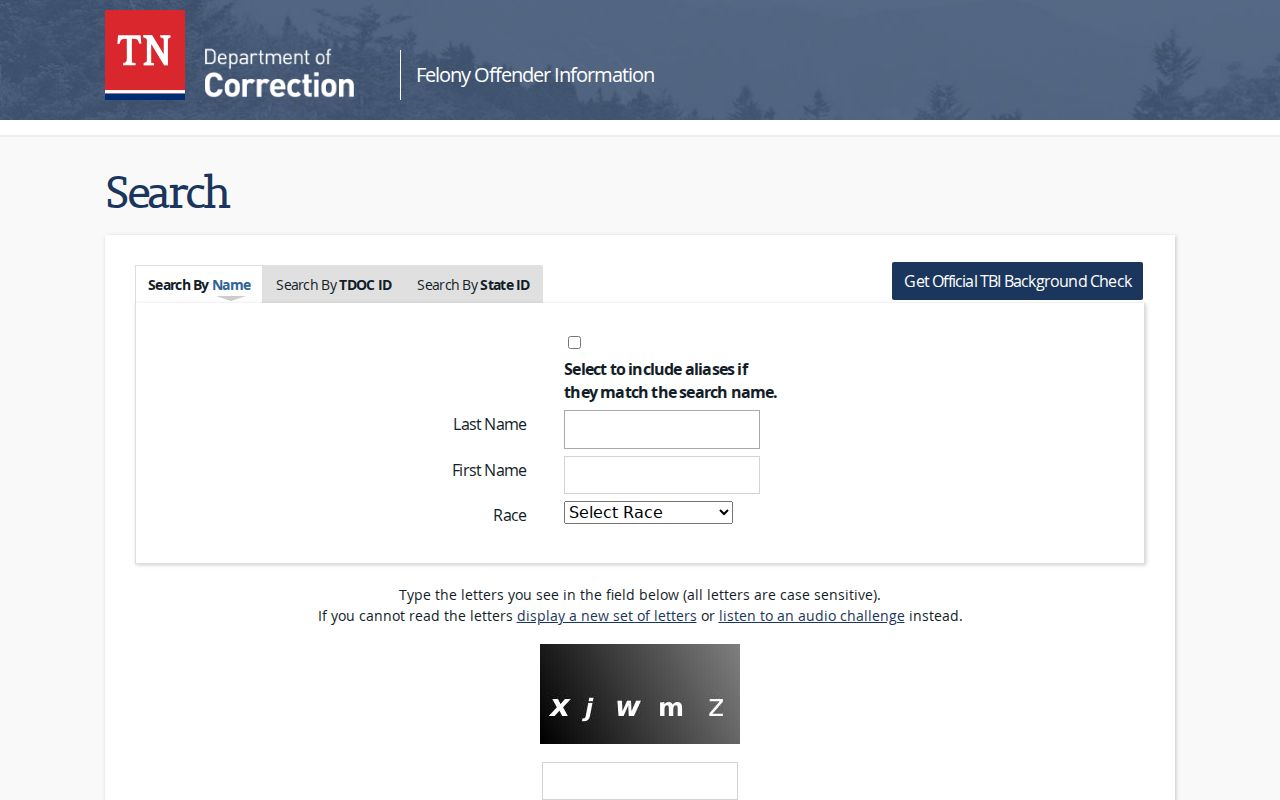
A FOIL result may show a photo, current status, location, offense, sentence, parole hearing, and release information. Registry and custody status can change, so save the date of the search and confirm a local booking with the Sheriff.
Franklin Records Terms Decoded
Office pages often use terms that describe access rather than the facts in a file. Knowing the distinction helps a requester ask for the right product and avoid paying for a form that does not meet the need.
- Index
- A finding aid with names and a record reference. It may not include the full document image.
- Certified copy
- A copy authenticated by the custodian, usually with a seal or formal certification.
- Custodian
- The office responsible for keeping and responding for a specific government record.
- Exemption
- A law or rule that closes a record or permits a protected part to be withheld.
A plain inspection may answer a fact question at no viewing charge. Certification is a separate service. If only one field is confidential, ask whether a redacted copy can release the parts that remain open.
Franklin Records Survived Civic Upheaval
Williamson County's record story does not fit the familiar burned-courthouse tale. The county was formed and Franklin founded as its seat in 1799. Three courthouse generations followed, and the current Greek Revival building dates from 1856 to 1858. It served as hospital space after the 1864 Battle of Franklin and sustained tornado damage in 1873. The official county history does not report a fire that destroyed its books.
The Archives was created in 1993 and moved from the Five Points Post Office basement to the former public library at 611 West Main Street in 2006. Original paper, bound books, microfilm, and scans now coexist. A separate county Records Center stores inactive departmental files, while the public Reading Room handles historical research. That custody split explains why an online name hit may still lead to a physical volume.
Note: Confirm unusual singleton years in the Archives site index with staff before treating them as firm collection coverage dates.
Franklin Records Fees and Copies
TPRA inspection is ordinarily free. Copies may carry duplication, media, delivery, and labor costs under the custodian's adopted policy. A requester cannot be forced to collect copies in person; after delivery charges are paid, an office must mail them. Ask for a written estimate before authorizing a large order, and narrow a date range or record type if the projected labor is high.
Fees differ by product. Tennessee vital certificates cost $15. Research identified a court-clerk schedule effective in 2026 with $0.50 per page for fulfilling a document request and $5 for certification or a seal, but the local clerk should confirm the amount before payment. The Register's public pages did not provide a verified copy-image price. Do not confuse its recording fee calculator with the fee for an existing deed copy.
Franklin Records Requests Under TPRA
The Tennessee Public Records Act, Tenn. Code Ann. §§ 10-7-501 through 10-7-505, generally gives Tennessee citizens access to inspect existing state, county, and municipal records. A custodian may ask for proof of citizenship. Franklin Police uses its own process, the Sheriff has a separate coordinator, and Williamson County directs other county requests through its Public Records Request Coordinator. Choose the custodian before drafting the request.
- Name the record and office. State the record type, people or property involved, department, and a narrow date span.
- Choose inspection or copies. Say whether an electronic file, paper copy, or certified copy is needed.
- Use the published channel. Submit through the office form, email, mail, or counter route and provide citizenship proof if requested.
- Track the response. Readily available material should be produced promptly. If that is not practical, the office has seven business days to produce, deny in writing, or give a written time estimate.
- Resolve cost or denial. Review any estimate, narrow the scope if useful, and ask for the exact exemption plus separable redacted material when access is denied.
The Williamson County request page lists the general county coordinator and the sheriff-specific route. The Office of Open Records Counsel can explain the law and offer informal advice, but it is not the custodian or an enforcement court. Judicial review proceeds by petition under Tenn. Code Ann. § 10-7-505.
When Franklin Records Are Withheld
A denial should identify the legal basis. Tennessee law can protect sealed or expunged cases, juvenile and adoption records, victim and witness data, recent vital files, Safe at Home addresses, Social Security numbers, driver-license identifiers, and motor-vehicle personal information. An office may also redact a protected field while releasing the rest. A commercial opt-out does not erase a lawful deed, assessment, or docket maintained by a custodian.
Use open records only for lawful personal research, civic review, family history, property questions, or scam verification. Tennessee harassment and stalking statutes can apply to threats, repeated unwanted contact, and conduct that causes fear or distress. The TBI registry carries its own warning against intimidation, stalking, or harassment.
Lawful use. Do not use names, addresses, case details, or registry data to track, threaten, harass, or harm a person. Public access is not permission for abuse.
Franklin Records Law Changes
Tennessee records law changed in 2025 and 2026. Public Chapter 392 made permanent the targeted rule that lets a custodian seek an injunction against requests made with intent to disrupt government operations. It does not turn a normal, focused request into misconduct. Effective July 1, 2026, Public Chapter 711 also gave a nonresident the narrow right to obtain a law-enforcement record or report that pertains solely to that person.
Other 2026 acts removed sunset dates from certain exemptions and made specified homeland-security critical-infrastructure material confidential. These shifts make current statutes and annual updates more reliable than an old exceptions summary. They also show why Franklin requesters should ask a custodian to cite the present exemption when material is withheld. The core method remains the same: request a defined existing record from the office that keeps it, then use written reasons and redaction rules to resolve any dispute.
Note: The Archives index also keeps growing, so its newer count should be dated rather than treated as a permanent total.